
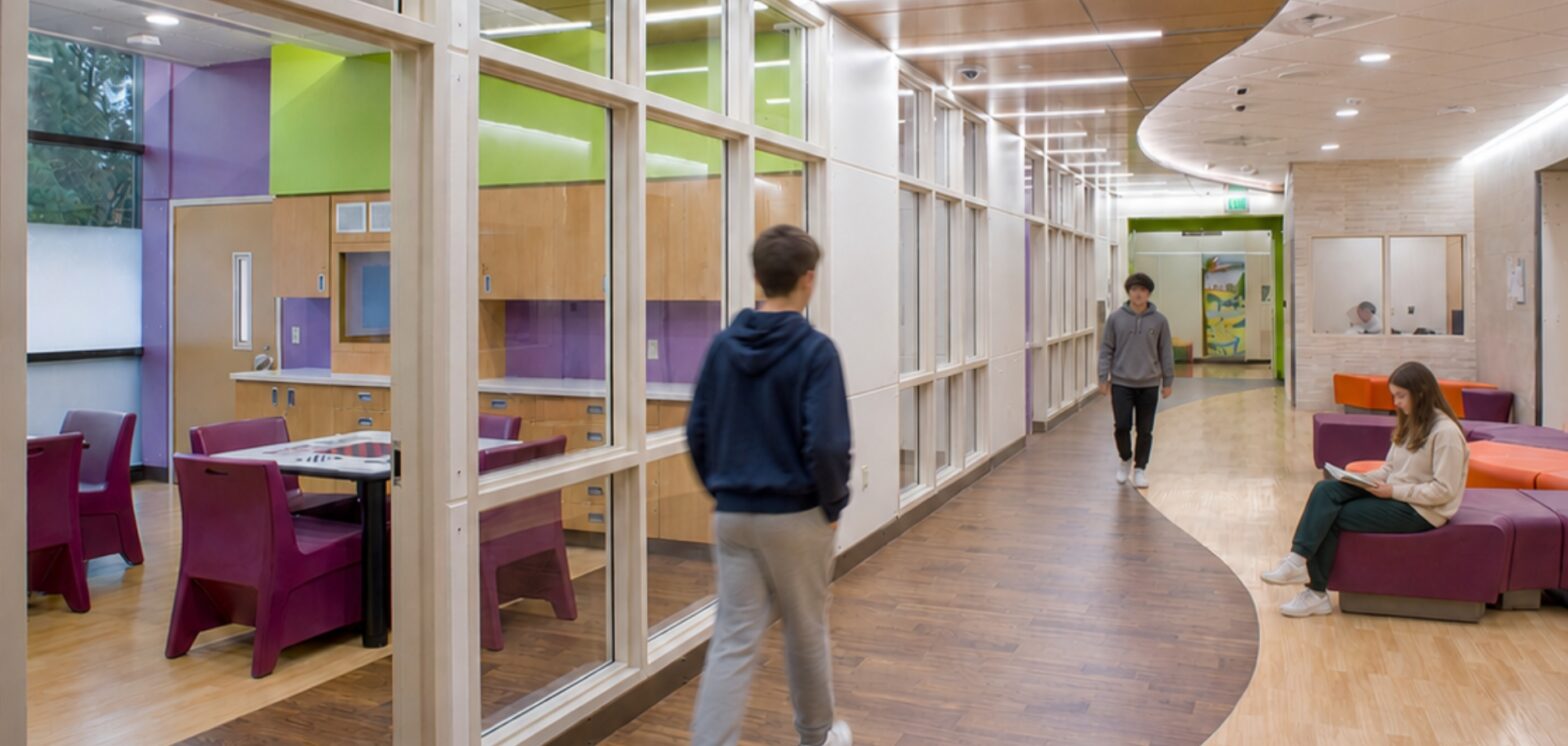
Behavioral health facilities present some of the most complex design challenges in healthcare architecture. Unlike an exam room or surgical suite, a behavioral health unit must simultaneously be safe, calming, flexible, and non-stigmatizing, often within the same floor plate. Every decision has clinical consequences.
We approach these projects as clinical problems as much as architectural ones. The questions we ask aren’t just about code compliance or spatial efficiency. They’re about what kind of environment actually helps people heal.
| Key question: What does the space communicate to someone arriving in crisis? Does it say “you are safe here” or “you are contained here”? The difference is legible immediately, and it shapes everything that follows. |
Where traditional design failed behavioral health patients
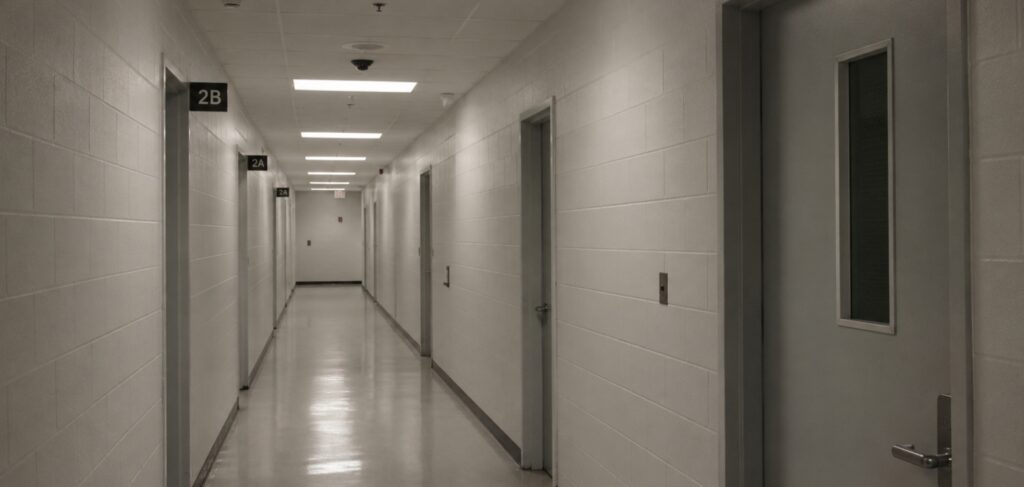
For much of the twentieth century, behavioral health units were adapted from general acute care facilities rather than purpose-built for their use. The results were predictable: environments that prioritized security and operational control over patient experience, often compounding distress rather than relieving it.
Three failures repeated across facilities:
Stigma built into the space
Units tucked in basements or behind unmarked doors signaled clearly how that care was valued. Physical isolation reinforced what patients already felt.
Safety through restriction
General hospital fixtures weren’t designed with ligature risk in mind. Retrofitting created workarounds, not solutions, leaving patients and staff exposed.
Environments that increased agitation
Fluorescent lighting, hard surfaces, and locked corridors produce measurable physiological stress. In settings where reducing anxiety is the goal, the building worked against the clinicians.
What intentional design actually accomplishes
Evidence-based design research is unambiguous: the physical environment influences clinical outcomes in behavioral health settings. Access to daylight reduces length of stay. Nature views lower agitation. Acoustic design affects sleep quality, which affects mood stability. These aren’t amenities. They’re clinical tools.
The most effective facilities we design share a few principles:
- Safety embedded, not applied. Anti-ligature hardware, tamper-resistant fixtures, controlled egress, and staff sightlines are built into the architecture from the start, not layered on after the fact. The goal is a space that is safe without feeling like a cage.
- Flexibility for evolving care models. Behavioral health treatment isn’t one-size-fits-all, and care delivery models keep changing. Spaces need to support individual therapy, group programming, crisis stabilization, and telehealth, often on the same unit. Adaptable layouts extend a facility’s useful life and reduce costly retrofits.
- Staff environments that support retention. Poor sightlines, no de-escalation spaces, and the absence of staff respite areas contribute directly to burnout. Design that reduces confrontational interactions and gives care teams room to decompress is an investment in the quality of care, not a luxury.
- Compliance as a floor, not a ceiling. Regulatory requirements from The Joint Commission, CMS, and state licensing bodies are non-negotiable. But the best projects ask what the standard was designed to protect, then go further.
On evidence-based design: A 2019 study in HERD: Health Environments Research & Design Journal found that behavioral health patients in units with access to outdoor spaces and natural light reported significantly lower anxiety scores and shorter average inpatient stays compared to those in conventional units.
The Bottom Line
The environment is not neutral. In behavioral health, it either supports recovery or works against it. Architecture that gets this right doesn’t just satisfy a program, it becomes part of how people heal.
We bring clinicians, administrators, and patient advocates into the design process from day one, because the people who use these spaces every day understand things no document can fully capture.